Town halls, villages, counties and special districts across New York all face the same growing challenge. They manage sensitive resident information, financial records, public safety systems and critical infrastructure, often with limited budgets and small IT teams. That combination makes local governments an attractive target for cybercriminals.
The good news: one of the most effective defenses is also one of the most affordable. It starts with your people.
New York State Offers Cybersecurity Training for Local Governments
To help close the gap, the New York State Office of Information Technology Services (ITS) makes cybersecurity awareness training available to local governments across the state. The program was originally built for New York State employees and has been extended to municipal workforces.
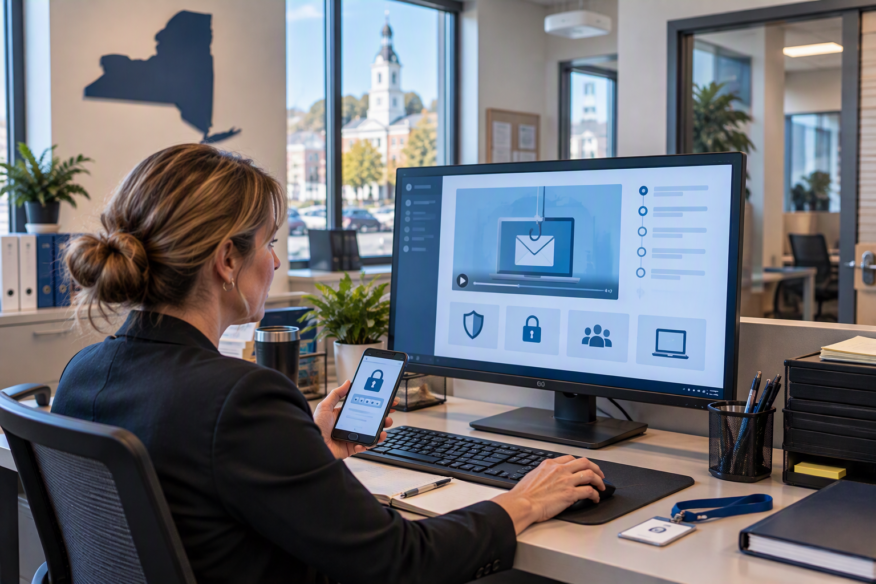
The online course helps employees understand security requirements, spot threats and vulnerabilities, recognize social engineering tactics and understand their role in protecting government information. It includes interactive exercises and takes about 25 minutes to complete. The state’s training portal also points to additional resources from organizations such as CISA, FEMA, SANS, Cybrary and the U.S. Cyber Challenge.
For a small municipality, that’s a valuable, low-cost starting point. Learn more about the program on the New York State ITS website.
The Human Factor Is Still the Biggest Risk
Municipalities invest in firewalls, endpoint protection, email security and backups. Yet many successful cyberattacks still begin with a simple human mistake: a clicked link, a reused password or a convincing phone call. Common threats facing local governments include:
- Phishing emails that steal passwords or install malware
- Business email compromise, such as fake vendor payment or wire requests
- Ransomware that locks up systems and data
- Credential theft leading to unauthorized access
- Social engineering by phone, text or in person
- Unsafe remote work practices
Why Local Governments Are Being Targeted
Municipalities hold a wide range of sensitive information, including resident records, tax and financial data, utility and public works information, emergency response details, employee records and public safety systems.
A successful attack can disrupt public services, create compliance problems and erode residents’ trust. That’s why cybersecurity awareness training is no longer just an IT project. It’s a business continuity, risk management and public service responsibility.
Training Works Best as Part of a Larger Security Plan
Security awareness training is most effective when it’s paired with strong technical protections. Every municipality should also consider:
- Multi-factor authentication (MFA): stops most attacks that rely on stolen passwords
- Endpoint detection and response (EDR): spots suspicious activity on computers before it becomes a major incident
- Email security: advanced filtering to catch phishing before it reaches inboxes
- Backup and recovery: regular backups of critical data, with recovery procedures that are actually tested
- Incident response planning: a documented plan for how incidents are reported, contained and resolved
- Ongoing education: regular training and phishing simulations, because awareness isn’t a one-time event
The message for local government leaders is simple: cybersecurity is everyone’s responsibility. Technology alone can’t stop every threat, and a security-aware workforce is one of the most cost-effective ways to reduce risk.
A Real Example From a New York Village
TCI recently helped a New York village government take a proactive approach to cybersecurity. Starting with a risk assessment, vulnerability scans and penetration testing, the village then added managed threat detection, firewall and email security, staff security awareness training and Microsoft 365 backup. Read the village government case study.
How TCI Technologies Helps Local Governments
TCI works with towns, villages, counties and public-sector organizations across New York to strengthen cybersecurity, modernize infrastructure and keep services running. Our IT services for state and local government include:
- Cybersecurity risk assessments
- Managed detection and response (MDR)
- Security awareness training and phishing simulations that build on the state’s program
- Email security and anti-phishing protection
- Microsoft 365 security and compliance
- Backup and disaster recovery
- Incident response planning
- Network and infrastructure modernization
By combining technology, policy and employee education, local governments can better protect critical systems and keep delivering the services their communities depend on.
Is Your Municipality Prepared?
Find out where you stand. Take our free Cybersecurity Risk Assessment to get your Security Readiness Score, or learn more about our IT services for state and local government. Prefer to talk? Call us at (516) 484-5151.