
What would you do if an email showed up in your inbox offering you an exclusive company gift? Would you click?
According to a report from Yahoo Sports, several Madison Square Garden employees faced exactly that question. They received an email announcing, “Congratulations, your Employee Championship Ring is here,” with two ring designs to choose from. Employees who clicked the link didn’t get a ring. Instead, they were reportedly enrolled in a mandatory cybersecurity class, because the email was a phishing test.
It’s a memorable example of one of cybersecurity’s biggest challenges: technology can protect your organization, but employees still need to recognize when something doesn’t look right.
Why This Phishing Test Worked
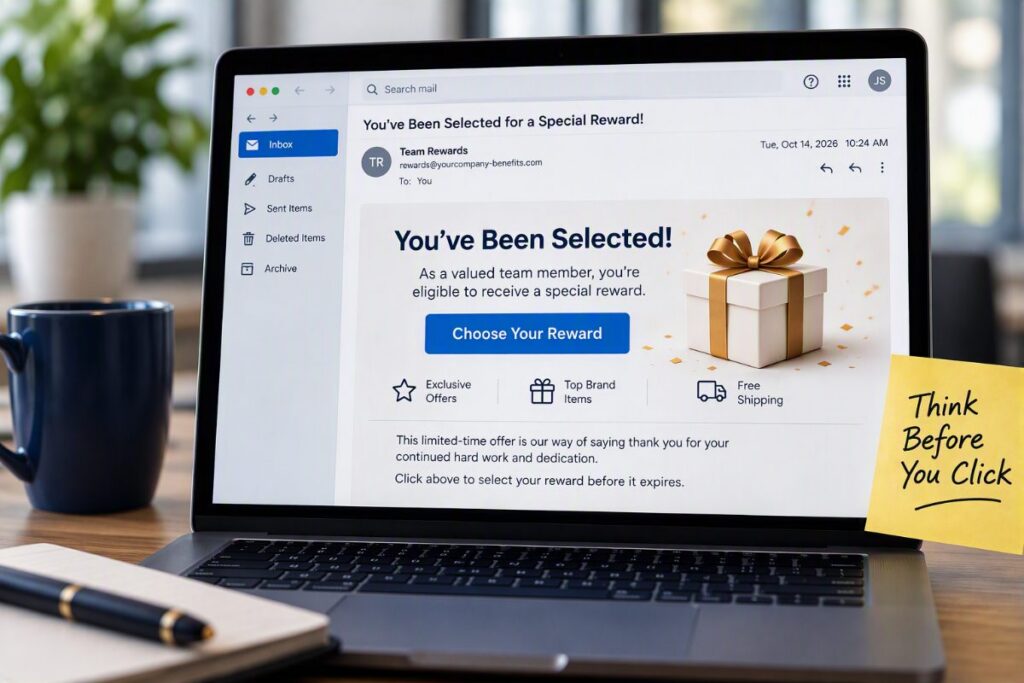
The email didn’t make an obviously suspicious request. It offered something employees might genuinely want, which is what makes social engineering effective. Attackers create believable reasons for people to click links, open files, enter passwords, or approve requests.
The championship ring email shows several warning signs every employee should learn to recognize:
-
- An unexpected offer or reward
- Pressure to act quickly
- A message tailored to something you care about
- A link that leads somewhere unexpected
- A request to sign in or provide information
- An offer just believable enough to lower someone’s guard
The same tactics can appear in fake Microsoft 365 notifications, password expiration notices, shared documents, invoices, payroll messages, delivery alerts, unusual MFA prompts and messages that appear to come from executives or vendors.
Before You Click, Ask These Five Questions
Employees don’t need to become cybersecurity experts. They do need to know when to pause.
-
- Was I expecting this message?
- Does the sender and request make sense?
- Where does the link actually go?
- Is the message asking me to sign in, approve something, or provide information?
- Can I verify the request another way?
And when something looks suspicious, always be sure report it instead of ignoring it.
Security Awareness Training Needs to Feel Real
Traditional cybersecurity training often becomes something employees click through once a year. Effective security awareness reinforces good habits with realistic situations employees may actually encounter.
A strong program can include:
-
- Phishing simulations: controlled test emails that help employees practice spotting suspicious messages before a real attack arrives
- Short, ongoing training: regular reminders throughout the year instead of one long annual session
- Microsoft 365 security education: how to recognize suspicious sign-in alerts, unexpected file-sharing requests, unusual MFA prompts, and fake login pages
- Clear reporting procedures: so everyone knows exactly what to do when something looks suspicious
Just as important, the goal should be to build a culture where employees feel comfortable reporting a mistake quickly. The sooner IT knows, the less damage an attacker can do.
The Goal Isn’t to Trick Employees
A phishing simulation gives an organization an opportunity to identify where more education is needed before a real attack arrives.
An employee who clicks a simulation has simply shown where more training will help. And your organization gets a chance to strengthen its defenses before a real attack arrives. A good program shifts the conversation from “Who failed the phishing test?” to “How do we help everyone recognize the next attack?”
Security Awareness Training is One Layer of Cybersecurity
Security awareness training shouldn’t stand alone. Businesses must also rely on important security technology, such as:
-
- Endpoint detection and response (EDR)
- Identity threat detection
- Email security
- Multi-factor authentication
- Microsoft 365 security controls
- Monitoring, backup, and recovery
- Managed detection and response
The strongest strategy combines technology designed to stop attacks with employees who know how to recognize and report suspicious activity. That’s why security awareness training should be part of a broader cybersecurity strategy, not a standalone compliance checkbox.
What Long Island and NYC Businesses Should Take Away
For businesses across Long Island, New York City, and the Tri-State area, the lesson is simple: your employees are a key part of your cybersecurity defense. Whether your business has 20 employees or hundreds, your employees are part of your cybersecurity defense.
Security awareness training and phishing simulations give them an opportunity to recognize suspicious activity in a controlled environment and build habits they can use when a real attack arrives.
The best time to teach someone to spot a phishing attack is before a real attacker sends one.
Build a Stronger Human Firewall With TCI Technologies
TCI Technologies helps businesses strengthen cybersecurity by combining security awareness training and phishing simulations with email security, endpoint protection, identity security, Microsoft 365 security, monitoring, and managed cybersecurity services. Instead of treating training as an isolated requirement, we build it into a security program designed around your people, systems, and risks.
How ready is your organization for the next phishing attempt?
Take our free Cybersecurity Risk Assessment to get your Security Readiness Score, or learn more about our Security Awareness Training. Prefer to talk? Call us at (516) 484-5151.