AI is quickly moving beyond answering questions and generating content. The next phase is agentic AI, where AI systems can plan, interact with applications, and complete tasks on a user’s behalf. Meta Muse for Business is one of the latest examples of this shift.
Meta has introduced AI agent capabilities that can work across connected applications, potentially helping businesses automate research, administrative work, and other everyday processes.
That makes Muse worth watching, but giving AI the ability to take action inside business applications also raises important questions about security, access, and oversight.
At TCI Technologies, we see potential in Muse, but we believe businesses should approach adoption carefully rather than rush into broad deployment.
TCI’s current position
Muse looks promising, but it needs more testing in real business environments before we’re comfortable recommending broad production use. Businesses interested in Muse should start with controlled testing, low-risk workflows and limited permissions while the platform and its governance capabilities continue to mature.
What Is Meta Muse and How Does It Work?
Meta Muse is an AI agent designed to go beyond traditional question-and-answer interactions. Instead of simply responding to a prompt, an AI agent can work through multiple steps to accomplish a goal.
According to Meta, Muse operates within a dedicated virtual environment called the Muse Secure VM. This gives the agent a virtual machine and browser where it can interact with applications and perform tasks. For example, rather than asking AI to explain how to complete a process, a user could potentially assign an agent the task itself.
Other AI platforms also offer agentic capabilities, but Muse’s approach emphasizes multi-step work across connected applications.
How Meta Muse for Business Works
Meta has introduced Muse for Small Business, extending its agent capabilities to applications organizations already use.
Supported integrations include:
-
- Finance and E-commerce: QuickBooks, Shopify, Stripe
- Collaboration and Productivity: Slack, Asana, Notion, Zoom
- File Storage: Box, Dropbox
- Marketing and Design: Canva, Klaviyo
- Social Media: Facebook business accounts and Instagram professional accounts
These connections could make Muse useful for automating tasks that currently require employees to move between several applications.
However, the ability to connect an AI agent to business systems doesn’t automatically mean it should have access to them.
What Are the Security Risks of Meta Muse for Business?
There’s an important difference between asking AI to summarize a financial report and allowing it to interact directly with the applications containing that financial information.
When an AI agent can access data, modify records, and perform actions, businesses need to consider:
-
- Application Access: What systems and information can the agent access?
- Permissions: What actions can it perform, and what requires approval?
- Data Protection: Could confidential business information be shared or exposed?
- Account Management: How are permissions reviewed and revoked?
- Monitoring: Can administrators track what the agent has done?
- Accountability: Who is responsible when the AI makes a mistake?
These concerns extend beyond traditional AI usage. They involve identity security, access management, data protection, and business governance.
What Safeguards Has Meta Introduced?
There are reasons to be optimistic. Meta says Muse’s architecture includes security and privacy controls, including the dedicated Muse Secure VM, and that users control which applications Muse can access. Meta also says Muse for Small Business requires user approval before certain consequential actions, such as publishing, sending, or spending.
Those are important safeguards. But they aren’t enough for us to say, “Connect Muse to your business and let it go.” The technology is simply too new for that recommendation.
Why TCI Thinks Muse Needs More Testing
The issue isn’t that TCI believes Muse is unsafe. It’s that there isn’t yet enough real-world business experience with it to confidently recommend broad access to sensitive systems.
Reuters reported that pre-launch testing of Muse identified concerns around sensitive information and unauthorized exposure, and that Meta had delayed an earlier release to improve security. That doesn’t mean businesses should avoid Muse. It means they should evaluate it the way they would any new technology with meaningful access to company systems: carefully.
Where We’d Start Testing Muse Today
A business doesn’t have to give Muse access to everything to determine whether the technology is valuable. In fact, we’d recommend doing the opposite.
If a TCI client wanted to evaluate Muse today, we’d start with low-risk, reversible workflows:
Research
Use Muse for research that doesn’t require confidential customer, employee, or company information.
Marketing
Test planning, research, and content workflows where an employee reviews the final work before anything is published.
Information Gathering
Gather and organize information from approved sources without modifying critical systems.
Routine Administration
Automate routine tasks while keeping employee approval for important actions.
Internal Workflows
Reducing repetitive administrative work in low-risk applications.
The purpose of a pilot is to find out whether Muse produces measurable value.
Where We Wouldn’t Test Muse Yet
For an initial business test, TCI would not give Muse unrestricted access to high-impact platforms or confidential information. We would avoid:
Financial Systems
Banking, payroll, payment authorization, and production accounting changes.
Administration Platforms
Microsoft 365, Google Workspace, and identity administration.
Cybersecurity Tools
Cybersecurity platforms, firewalls, and RMM or remote-management tools.
Sensitive Data
Customer passwords or credentials, sensitive HR information, or client data.
Production Infrastructure
Business-critical servers, networks, and systems.
Being able to connect AI to an application doesn’t automatically mean you should.
Human Approval Should Remain Part of the Process
This is probably the most important requirement for businesses evaluating agentic AI today. An employee should stay responsible for consequential actions, especially before an agent:
- Sends an email
- Publishes content
- Changes business information
- Modifies a customer record
- Creates a financial transaction
- Changes permissions
- Deletes information
- Communicates externally
- Approves something
- Spends money
That doesn’t eliminate the productivity benefit. The agent can still research, organize, prepare, recommend, and complete lower-risk steps.
But there should be a clear boundary between preparing an action and authorizing an action.
How TCI Would Pilot Muse for Small Business
Rather than rolling Muse out company-wide, we’d recommend treating the initial deployment like a structured technology pilot.
- Choose One Business Problem
Don’t start with “Let’s see what Muse can do.” Instead, start with something measurable: “This process takes an employee 60 minutes every week. Can Muse safely reduce that to 20 minutes?” - Start With a Small Group
Begin with one or two employees who understand the workflow and can recognize when Muse produces an incorrect or unexpected result. - Use Least-Privilege Access
Connect only the applications and information required for the workflow being tested. If Muse doesn’t need access to an application to complete the pilot, don’t provide it. - Avoid Sensitive Information
An initial proof of concept shouldn’t require highly confidential, regulated, or business-critical information. - Require Approval for Consequential Actions
An employee should remain accountable for high-impact decisions while you’re establishing how reliably the agent performs. - Measure What Happens
Track time saved, accuracy, errors, employee intervention, failed tasks, unwanted actions, permission issues, and security concerns. - Expand Slowly
If Muse consistently produces useful results, expand the pilot one variable at a time (e.g., another workflow, employee, or application). This makes it easier to understand what changed if problems emerge.
What “measurable” looks like: if a task normally takes 60 minutes and Muse cuts it to 20 with acceptable accuracy and no new security problems, that’s meaningful. If an employee spends 45 minutes correcting Muse’s work, you haven’t solved much. Expansion should follow demonstrated value, not curiosity.
Muse vs. Other AI Assistants
Businesses shouldn’t approach Muse with the assumption that it automatically replaces the AI platforms they already use. The right tool depends heavily on the organization’s existing technology and the work being performed.
Microsoft Copilot
Makes sense for organizations working heavily in the Microsoft 365 ecosystem.
Google Gemini
Aligns naturally with Google Workspace environments.
ChatGPT
A flexible, general-purpose AI workspace.
Claude
Useful for analytical and document-heavy workflows.
Grok
Evolving as another managed business AI platform.
Muse’s significance is its focus on AI that carries out multi-step work across applications. Which approach is right depends on what your organization is actually trying to accomplish. Compare AI platforms side by side →
Why We’re Watching Muse Closely
We aren’t cautious because we think AI agents are going away. Quite the opposite: they could become one of the most important changes in business technology. We’re moving from AI that answers, to AI that creates, to AI that acts.
Meta is continuing development of newer Muse Wonder models for increasingly sophisticated personal and professional agentic tasks. As these systems mature, businesses may come to rely on AI agents for a significant amount of routine work. But the more an AI system can do, the more carefully organizations need to control what it can access and what it’s allowed to change.
TCI’s Current Position on Meta Muse
We’re interested, and we’re watching closely. But we’re not ready to recommend broad business deployment yet. Muse is an important technology to watch, and controlled pilots make sense for organizations interested in agentic AI. For now, we recommend:
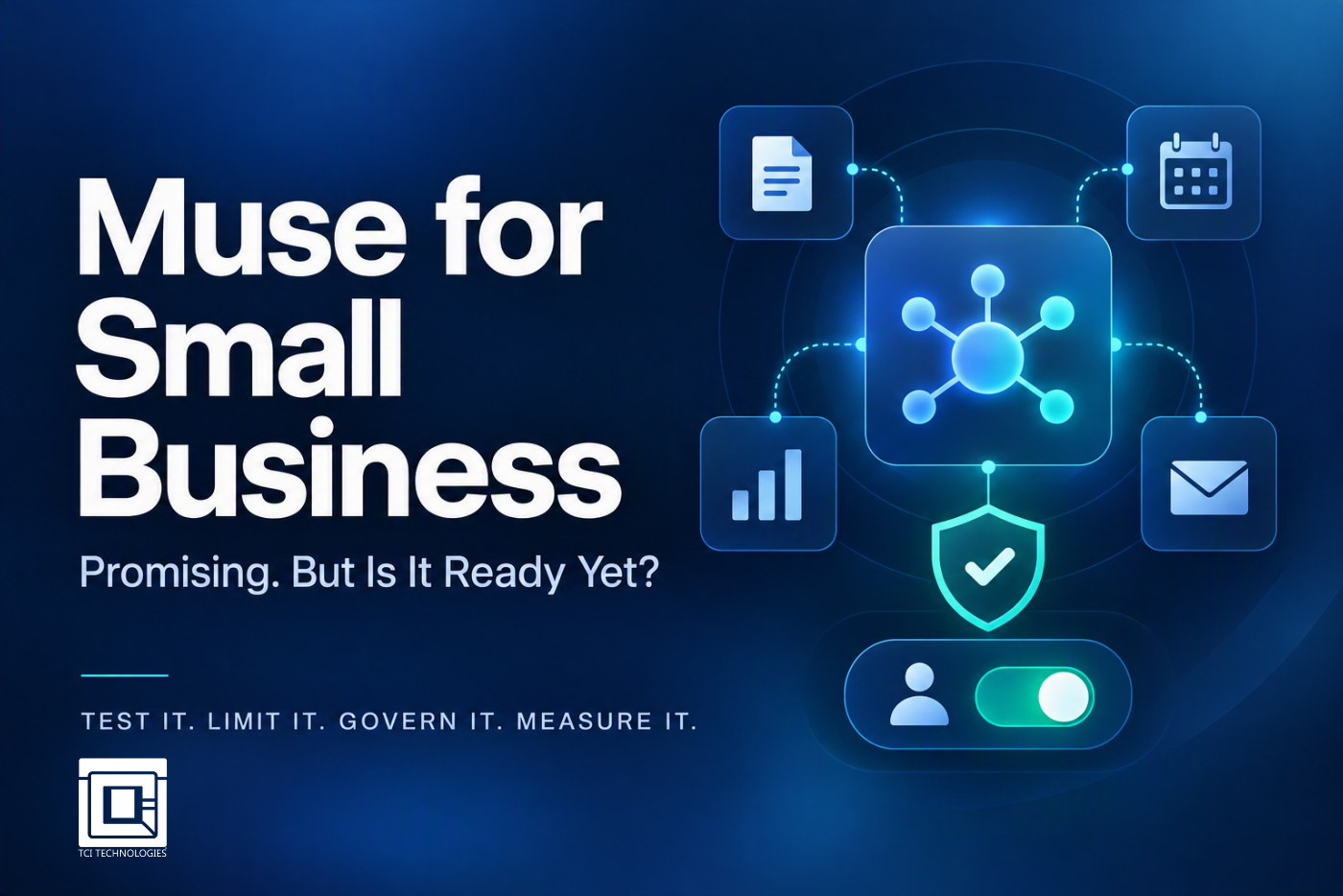
Test it. Limit it. Govern it. Measure it. Then decide whether to expand it.
We want to see more real-world business use, security experience, administrative controls and governance maturity before recommending widespread production deployment in the environments we support. That’s not anti-AI. It’s how businesses should approach any new technology that can take action across important company systems.
Thinking About AI Agents for Your Business?
You don’t have to deploy every new AI platform to start preparing for agentic AI. TCI Technologies helps businesses evaluate AI platforms, develop AI governance policies, secure company data, train employees and identify practical opportunities for AI and automation. We’ll keep evaluating technologies like Muse as they mature, and help our clients understand when they’re interesting, when they’re useful and when they’re ready for the business environment.
Talk to TCI About AI Strategy & Governance →